
The cabin lights have dimmed. Dinner trays are gone. Half the plane has entered that peculiar red-eye silence in which everyone appears to be sleeping except you.
Your neighbor has a neck pillow the size of a life preserver. Someone across the aisle is wearing an eye mask worthy of a lunar expedition. You have folded your sweatshirt into a pillow for the third time, and your head keeps dropping forward just as sleep begins to arrive.
This is where the market for flight accessories for sleeping makes its case. There are pillows, masks, earbuds, blankets, footrests, hooded contraptions, and enough specialized equipment to make an economy seat resemble a campsite.
But sleeping better on a plane does not require carrying a bedroom through security.
The most useful accessories solve four stubborn problems: unstable head position, unwanted light, persistent noise, and physical discomfort. Everything else should have to prove that it deserves space in your carry-on.
There is another distinction worth making before buying anything: sleeping on the aircraft and preventing jet lag are not the same task. An accessory can make a seat more tolerable, but it cannot reset your internal clock on command. The smartest in-flight sleep kit works with your travel schedule rather than simply trying to make you sleep whenever the cabin lights go dark.
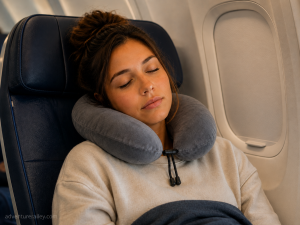
1. Your Neck Pillow Has One Job
A neck pillow has one serious assignment: keep your head from wandering once you fall asleep.
The problem is not merely lack of softness. As you drift off upright, your head can tilt sideways or drop forward, jolting you awake just as sleep arrives. A pillow that feels plush while you are reading may do very little once your neck muscles relax.
That is why support matters more than bulk.
Look for a pillow that braces the sides of the head and provides some resistance to forward drop. Taller side panels, adjustable closures, wraparound designs, or scarf-style supports can work better for some travelers than a loose U-shaped ring of foam.
Fit is personal. A large memory-foam pillow may swallow a smaller traveler; a low-profile design may offer almost no support to someone with a longer neck. Travelers who naturally sleep with their head angled to one side may prefer a support that deliberately accommodates that position.
Before bringing any pillow onto an overnight flight, test it at home in an upright chair. If you spend 20 minutes repositioning it, pulling it away from your jaw, or wondering where it is supposed to sit, eight hours in economy will not improve the relationship.
The best neck pillow is not the biggest one. It is the one you stop noticing.
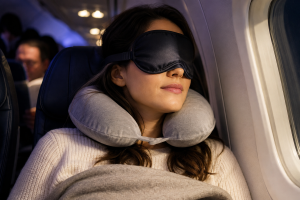
2. Block the Cabin Glow: Why a Good Eye Mask Matters
Aircraft cabins are rarely truly dark, which is why a good eye mask can outperform accessories many times its size.
Reading lights appear without warning. Seatback screens flicker. Galley curtains open. Window shades rise. A passenger three rows ahead decides that 4:17 a.m. is the ideal moment to investigate the sunrise.
A well-fitted mask gives you something valuable on a shared aircraft: control.
Look for a design that blocks light around the nose without pressing hard against the eyes. Contoured masks can be particularly comfortable because they create space around the eyelids and eyelashes. An adjustable strap helps prevent the two common failures of cheap masks: light leakage when they are too loose and pressure when they are too tight.
Material is secondary to fit. Expensive fabric cannot compensate for a glowing triangle beside your nose.
There is also a reason to think about when you put the mask on. CDC guidance on jet lag emphasizes coordinating sleep and light exposure with the destination schedule and notes that eye masks and earplugs can help with in-flight naps.[1]
So darkness is useful, but strategic darkness is better.

3. Small but Mighty: Earplugs for Quieter In-Flight Sleep
Earplugs may be the least glamorous item in your sleep kit, which is precisely why they are easy to underestimate.
They weigh almost nothing, require no charging, do not compete with your neck pillow, and can remain permanently tucked into a carry-on pocket.
Their purpose is not to create absolute silence. Aircraft cabins contain a mixture of continuous engine and airflow noise, conversation, announcements, crying children, and intermittent galley clatter. Earplugs simply reduce how much of that environment demands your attention.
Fit determines whether they work.
Foam plugs need to be inserted properly to provide useful attenuation. Reusable silicone designs can feel more comfortable for travelers who dislike the expanding pressure of foam. Whichever type you choose, the real test is whether you can tolerate them for several hours.
CDC/NIOSH guidance on reducing circadian-related sleep disruption specifically recommends earplugs and eye masks for reducing noise and light.[2]
For an accessory smaller than a house key, that is a strong case for permanent carry-on status.
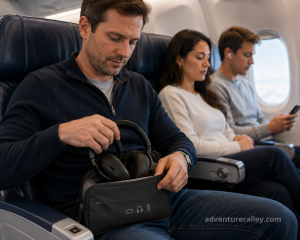
4. When Noise-Canceling Gets Uncomfortable
Noise-canceling headphones can make a cabin feel dramatically calmer. The problem begins when the device that reduces the noise starts interfering with your sleeping position.
Over-ear models are excellent while you are awake. They soften the steady cabin drone, improve entertainment audio, and make conversation around you less intrusive.
Sleeping in them is another matter.
Large earcups can become warm over several hours. Lean against the window or headrest and the headphones may press into the side of your head. Pair them with a thick neck pillow and suddenly two excellent accessories are fighting for the same territory.
Travelers who sleep upright with their head centered may have no problem. Side-leaners often do.
Sleep-oriented earbuds solve some of that bulk, but introduce their own compromises: batteries, charging cases, wireless connections, and tiny components capable of disappearing into a seat seam.
The sensible approach is to upgrade only when the simpler option has failed you. If ordinary earplugs let you sleep, you may not need an electronic solution at all.

5. Cold Cabin, Restless Sleep: Pack for Warmth
A perfectly dark, quiet seat is still difficult to sleep in if you are cold.
Temperature discomfort tends to receive less attention than pillows and headphones because there is no particularly exciting gadget attached to it. Yet a draft across your shoulders or cold legs can keep you shifting position long after the lights go out.
The smartest answer is usually a multipurpose layer, not a bulky dedicated travel blanket.
A soft hoodie, oversized scarf, merino layer, or lightweight insulated jacket can provide warmth during the flight and remain useful after landing. A large scarf is especially efficient: it can cover your shoulders, protect your neck from a vent, act as light lumbar padding, or become a clean barrier between your face and the seat.
A compact blanket can still make sense if you consistently run cold. But if it occupies half your personal item and serves no purpose outside the aircraft, it should face a higher bar.
The best sleep gear earns its space more than once.
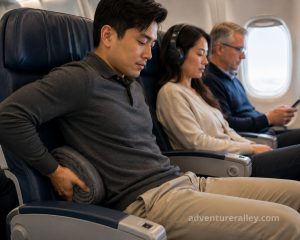
6. Back Support Matters: A Simple Fix for Seat Discomfort
Your neck may be complaining, but your lower back can be the reason you never settle.
Airline seats vary in contour and support. If a seat leaves an uncomfortable gap behind your lower back—or encourages you to slump—you may spend the flight repeatedly shifting without identifying the source of the problem.
You probably do not need to pack a dedicated lumbar pillow.
A tightly rolled blanket, scarf, compressible jacket, or small soft pouch can often provide enough support behind the lower back to change how the entire seat feels.
The point is not to engineer textbook posture at cruising altitude. It is to make a rigid seat adapt a little more closely to your body.
This is one of the better examples of improvised travel gear: a problem solved by something already in the bag.
7. Keep Your Sleep Tech Charged: Power Banks in Flight
If your sleep routine depends on wireless earbuds, downloaded audio, white noise, or a phone running through the night, battery life becomes part of the system.
A compact power bank can therefore be a legitimate sleep accessory—but one that comes with aviation rules.
Under current FAA guidance, spare lithium batteries, including power banks and portable chargers, must remain in carry-on baggage rather than checked baggage. Rechargeable batteries from 0–100 Wh are generally allowed on passenger aircraft. Batteries rated 101–160 Wh require airline approval, and passengers are limited to two spare batteries in that larger range per person. Batteries above 160 Wh are generally forbidden for ordinary passenger carriage, while individual airlines may impose stricter limits.[3]
If your carry-on is gate-checked, remove the power bank before handing over the bag.
That makes a simple rule worth remembering: if your sleep setup needs electricity, know what is powering it and where that battery is packed.
8. Clever or Clutter? Sleep Gadgets Worth Questioning
Foot hammocks, inflatable footrests, oversized pillows, hooded sleep systems, and other specialized gadgets can look irresistible before a long flight.
Some work well. Some merely relocate the discomfort.
A foot hammock may feel excellent to a shorter traveler but awkward to someone with long legs. An inflatable footrest consumes floor space and requires setup. An enormous pillow may support your head beautifully while becoming a nuisance through terminals, boarding lines, and connections.
The more specialized the accessory, the more important it is to ask whether it solves a recurring problem.
If you have taken six overnight flights and wished for exactly the same thing each time, the gadget may have earned a trial. If you saw it in a packing video yesterday and have never previously noticed the problem it claims to solve, skepticism is useful.
Preparedness and overpacking are close relatives.
9. Build a Better In-Flight Sleep Kit
A good sleep kit should be built in layers, beginning with the smallest tools that address the biggest problems.
Start with an eye mask and earplugs. Together, they reduce light and noise while occupying almost no luggage space.
Add neck support if head movement normally wakes you. Bring a warm layer that can serve other purposes during the trip. Use a rolled blanket or garment for lower-back support if the seat demands it.
Only then consider electronic upgrades such as sleep earbuds, noise-canceling headphones, or a power bank.
This order matters because it prevents the kit from turning into a collection of solutions in search of problems.
The goal is not to own every accessory recommended for red-eye flights. It is to identify what usually keeps you awake and remove those obstacles with the least equipment possible.
10. Timing Matters: When to Sleep on a Flight
Even a perfect sleep kit cannot answer the most important question for you: should you be sleeping right now?
Jet lag results from rapid travel across time zones that leaves your internal clock misaligned with local time. CDC guidance recommends timing sleep and light exposure around the destination schedule when practical.[1]
That means the longest available sleep window is not always the most useful one.
If sleeping immediately after departure means waking at what will be the middle of the night at your destination, you may arrive feeling less synchronized rather than more. Conversely, creating darkness with your eye mask when it corresponds more closely with destination nighttime can make the same accessory strategically useful.
This is where many “best flight accessories” lists stop too early.
Gear can remove obstacles to sleep. It cannot decide when that sleep best serves the journey.
11. Pack for Better Sleep, Not More Gear
The best flight accessories for sleeping are usually the ones that disappear from your attention once they begin working.
A mask turns the flashing cabin dark. Earplugs make the surrounding noise less demanding. A neck support keeps your head from wandering. A warm layer stops a draft. A rolled blanket makes an unforgiving seat more tolerable.
None of those things needs to be elaborate.
You do not need to reproduce your bedroom in row 34. You need to eliminate enough friction that your body has a reasonable chance to rest.
That is the useful standard for every accessory you consider adding to your carry-on: Does it solve a real sleep problem better than the space, weight, and effort it costs?
If the answer is yes, pack it.
If not, leave room for the trip instead.
References
- Centers for Disease Control and Prevention — Jet Lag Disorder, CDC Yellow Book. Guidance on circadian disruption, destination-time sleep scheduling, light exposure, and the use of eye masks and earplugs during flight.
https://www.cdc.gov/yellow-book/hcp/travel-air-sea/jet-lag-disorder.html - CDC/NIOSH — Aircrew and Jet Lag. Guidance on reducing light and noise when sleeping, including use of earplugs and eye masks.
https://www.cdc.gov/niosh/aviation/prevention/aircrew-jetlag.html - Federal Aviation Administration — Airline Passengers and Batteries. Current U.S. guidance on power banks, carry-on requirements, watt-hour thresholds, airline approval, and the two-spare-battery limit for 101–160 Wh rechargeable batteries. Updated August 10, 2026.
https://www.faa.gov/hazmat/packsafe/airline-passengers-and-batteries