
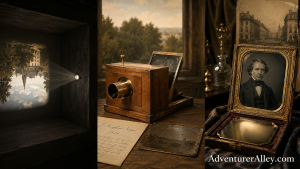
When Was the First Camera Invented? The Answer Depends on What You Mean by “Camera”
Ask when the first camera was invented and you might expect a clean date, an inventor’s name, and perhaps a tidy museum label. Camera history refuses to cooperate. Depending on what counts as a “camera,” the answer can land in the ancient world, the 17th century, the 1820s, or 1839.
That ambiguity is not a historical nuisance. It reveals what a camera actually is. Long before anyone could preserve a photograph, people knew how to project an image. The decisive invention was not simply a box with a hole or lens. It was a system that could make light leave a durable record.
So, when was the first camera invented? The most useful answer is this: the optical ancestor of the camera is centuries old, but the first surviving photograph made in a camera dates to 1827, the work of French inventor Joseph Nicéphore Niépce. The photographic camera as a practical public technology arrived soon afterward, with Louis Daguerre’s daguerreotype process in 1839.
The Camera Existed Before Photography
The word camera comes from camera obscura, Latin for “dark chamber.” At its simplest, a camera obscura is a darkened space with a small opening. Light from the outside passes through that aperture and projects an inverted image of the external scene onto an opposite surface.
There is nothing electronic or even necessarily mechanical about it. It is geometry made visible.
Knowledge of the pinhole-image effect reaches far back. The National Science and Media Museum notes that the phenomenon appears to have been known in ancient China by the fourth century BCE and was described outside China by the scholar Ibn al-Haytham, known in Latin as Alhazen, around 1030. By the Renaissance, descriptions became more sophisticated, and by the mid-16th century lenses were being used to make projected images brighter and sharper. Portable camera obscuras appeared by the 17th century, eventually taking the form of boxes that artists could use as drawing aids.
These devices were recognizably camera-like. They had an enclosed body, an aperture or lens, and a surface on which an image appeared. What they did not have was a way to save that image automatically.
That distinction matters. A camera obscura could show you the world, but it could not remember it.
The Hard Problem Was Not Seeing an Image. It Was Keeping One.
By the late 18th and early 19th centuries, experimenters were beginning to combine camera optics with light-sensitive chemistry. The central problem was “fixing” an image: making the changes produced by light stable enough that the picture would not continue darkening or disappear when exposed to normal viewing conditions.
This is where Joseph Nicéphore Niépce enters the story.
Niépce began experimenting with camera images in the 1810s. The Harry Ransom Center at the University of Texas at Austin records that in 1816 he produced legible but fleeting camera images. They were a technical success in one sense and a practical failure in another: the image existed, but it did not yet endure.
Niépce spent the next decade experimenting with materials and processes. His breakthrough involved bitumen, a light-sensitive substance he dissolved in oil of lavender and spread over a polished pewter plate. He placed the plate in a camera obscura pointed from an upstairs window at his estate in Burgundy and exposed it to daylight for an extraordinarily long period—several days, according to the Ransom Center.
The resulting image, now known as View from the Window at Le Gras, dates to 1827 and is the earliest photograph produced with a camera obscura known to survive.
It is not visually impressive by modern standards. The view is pale, rough, and difficult to read at first glance. Yet its historical significance is hard to overstate. The surviving heliograph preserved a camera-projected scene as a durable object, making it the earliest such image known to survive.
Why You Sometimes See 1816, 1826, or 1827
This is where many short histories become confusing.
You may encounter 1816 as the date of the first camera because that was when Niépce was already making photographic experiments with camera images. You may also see 1826 attached to the “first photograph,” particularly in older accounts. The Harry Ransom Center, which holds the surviving Niépce heliograph, currently dates View from the Window at Le Gras to 1827.
The safest formulation is therefore not “the camera was invented in 1827.” Cameras in the optical sense already existed. Rather, 1827 marks the earliest surviving photograph made with the aid of a camera obscura.
That sounds like a technical distinction, but it prevents a major historical error. Invention rarely occurs in a single theatrical moment. Technologies are usually assembled from older components whose importance changes when they are combined.
A modern camera still follows that pattern. It requires optics to form an image, a light-sensitive surface or sensor to record it, a mechanism to control exposure, and a method of storing the result. Niépce did not invent every part. His achievement was making the chain of image formation and durable recording work.
Then Came Daguerre—and Photography Became Public
Niépce’s process was pioneering, but it was not yet convenient enough to transform everyday image-making. Exposure times were punishingly long, and the method was not ready for broad use.
In 1829, Niépce entered a partnership with Louis-Jacques-Mandé Daguerre, a French artist and theatrical designer who had also been experimenting with camera images. Niépce died in 1833, leaving Daguerre to continue the work.
Daguerre’s breakthrough produced a sharper and more workable photographic process. On January 7, 1839, examples were shown to members of the French Académie des Sciences. In August of that year, the process was publicly explained. The daguerreotype used a highly polished, silver-plated copper sheet that was sensitized, exposed in a camera, chemically developed, and fixed. Each plate produced a single, highly detailed image rather than a negative from which multiple identical prints could be made.
This is why 1839 is often called the year photography was born. It was not the year humans first understood camera optics, nor the year the first durable camera image was achieved. It was the year a workable photographic process entered public consciousness and began spreading rapidly.
If Niépce proved that a camera could preserve a view, Daguerre helped turn that proof into a medium.
The First Camera Was Not One Machine
The urge to identify “the first camera” reflects the way we tell stories about invention: one genius, one machine, one date. Camera history is a useful correction to that habit.
A camera is not one invention. It is a stack of inventions.
The camera obscura supplied the optical principle. Lens makers improved the image. Chemists and experimenters discovered materials that reacted to light. Niépce found a way to preserve a camera-made scene. Daguerre made the process dramatically more practical and visible to the public. Later innovations would introduce reproducible negatives, faster exposures, dry plates, roll film, compact consumer cameras, color photography, electronic sensors, and computational imaging.
At each stage, the object called a “camera” changed because the problem people expected it to solve changed.
For an artist using a camera obscura, the camera was a seeing and drawing instrument. For Niépce, it became a device for persuading light to write permanently. For the daguerreotypist, it became a portrait-making machine. For later amateurs, it became a portable memory device. Today, the camera in a smartphone is partly optical hardware and partly software, with algorithms performing tasks that once depended on chemistry, mechanics, and darkrooms.
So, When Was the First Camera Invented?
If the question means, “When did people first use the basic optical principle behind a camera?” the answer reaches back more than two thousand years.
If it means, “When did camera-like devices become portable tools?” that development was underway by the 17th century.
If it means, “When did a camera first create a photograph that still survives?” the strongest answer is 1827, when Joseph Nicéphore Niépce produced View from the Window at Le Gras.
And if it means, “When did photography become a practical, publicly introduced technology?” 1839 is the landmark year associated with Daguerre.
The most accurate answer, then, is not a date but a sequence. The camera was invented in layers: first as a way to project the world, then as a way to preserve it, and finally as a tool ordinary people could use.
That progression explains why the first camera can seem both ancient and surprisingly modern. The essential idea—a controlled opening admitting light into a dark space—changed very little. What changed everything was humanity’s ability to make that light stay.
References
- National Science and Media Museum. Introduction to the Camera Obscura
- Harry Ransom Center, The University of Texas at Austin. The Niépce Heliograph
- Malcolm Daniel, The Metropolitan Museum of Art. Daguerre (1787–1851) and the Invention of Photography