
Oregon rewards travelers who stop thinking of it as a checklist.
On a map, the state looks manageable: one Pacific coastline, one famous city, a spine of Cascade peaks, and a broad eastern half that many first-time visitors barely consider. On the road, Oregon keeps changing character. Salt air gives way to vineyard country. Mossy waterfalls yield to volcanic high desert. Farther south, an impossibly blue lake occupies the remains of an ancient volcano. Drive east long enough and the crowds thin until the horizon seems to belong to you.
That variety is the real answer to the question, “Where should I go in Oregon?” There is no single best place. The better question is what kind of Oregon you want: cinematic coast, food-and-wine country, mountain adventure, urban culture, or genuine remoteness.
The smartest trip does not try to see everything. It chooses a few landscapes and leaves enough room to experience the transitions between them.
Start in Portland, but Do Not Mistake It for the Whole State
Portland is the natural starting point for many Oregon trips, and not simply because of its airport. The city introduces several themes that recur throughout the state: independent businesses, serious attention to food and coffee, abundant green space, and neighborhoods that often matter more than marquee attractions.
Give Portland at least a day or two. Walk through the Pearl District, cross the Willamette River to explore the east side, browse Powell’s City of Books, and leave time for Washington Park and its gardens.
Yet Portland works best when treated as an opening chapter rather than the entire story.
Its greatest advantage is what lies just beyond it. Within a relatively short drive, city blocks give way to waterfalls, forests, vineyards, and the Columbia River. Few major cities make such dramatic landscape changes feel so immediate.
Follow the Columbia River Gorge for Waterfalls and Scale
East of Portland, the Columbia River Gorge compresses some of Oregon’s most dramatic scenery into a corridor of cliffs, forests, waterfalls, and broad river views.
Multnomah Falls receives most of the attention, understandably. The two-tier waterfall framed by Benson Bridge is one of the state’s defining images. But arriving, taking a photograph, and immediately leaving misses what makes the Gorge compelling.
Latourell Falls, Bridal Veil, Crown Point, and the overlooks along the Historic Columbia River Highway turn the drive itself into part of the experience. Continue east and Hood River provides an excellent base for hiking, orchards, restaurants, breweries, and time along the Columbia.
There is one important 2026 planning detail. During the summer permit period, travelers using the I-84 Exit 31 parking area for Multnomah Falls need a timed-use permit during designated daytime hours. The requirement applies to that access point rather than the Historic Columbia River Highway itself, although parking elsewhere can be limited.[1]
The distinction matters. The Gorge is remarkably accessible, but its most popular sites are no longer places where every summer visitor should expect to arrive without a plan.

Go to the Oregon Coast for Drama, Not a Conventional Beach Holiday
Oregon’s coast does not promise the standard beach fantasy. The Pacific is cold. Fog can arrive in summer. Wind and rain remain possibilities even when the forecast appears cooperative.
That unpredictability is part of the appeal.
Oregon has 362 miles of shoreline, and public coastal access is protected by a framework that includes the state’s landmark 1967 Beach Bill.[2] The result is a coastline that feels unusually open: beaches are places to walk, explore tide pools, watch storms, and stand beneath enormous headlands rather than simply reserve a patch of sand.
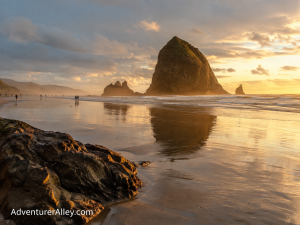
For a first visit, Cannon Beach is the obvious introduction. Haystack Rock supplies the famous view, but nearby Ecola State Park provides the larger perspective—forested cliffs, offshore rocks, and the Pacific stretching beyond them.
Travel farther south and the atmosphere changes. Yachats feels smaller and rougher around the edges, with waves meeting dark volcanic shoreline. Bandon, farther down the coast, is known for extraordinary offshore formations that become particularly striking in the lower light of morning and evening.
The mistake is trying to “do the Oregon Coast” in a single day. Choose a section. Stay overnight. Let fog, tides, and weather rearrange your plans.
The coast becomes more interesting when you stop fighting its unpredictability.
Slow Down in the Willamette Valley
South and southwest of Portland, the Willamette Valley introduces another Oregon entirely. Here, the drama becomes quieter: vineyard-covered hills, farmland, tasting rooms, small towns, and back roads that reward deliberate detours.
Pinot noir may be the region’s international calling card, but wine alone is too narrow a reason to visit. McMinnville, Dundee, Newberg, and Carlton form an easy framework for a food-and-wine trip, while bakeries, farm stands, restaurants, and seasonal produce make the valley feel connected to agriculture rather than constructed solely for tourism.
The common mistake is overbooking.
A schedule packed with tasting-room appointments turns a leisurely landscape into an endurance event. Two or three thoughtful winery visits, a long lunch, and an unhurried evening in McMinnville generally reveal more of the region than racing through six stops.
This is Oregon at its most cultivated, but rarely its most formal.
Choose Bend for the Cleanest Collision of Town and Wilderness
Cross the Cascades toward Bend and the environment changes with startling speed. The wetter forests of western Oregon begin to give way to ponderosa pine, juniper, sage, exposed lava, and the enormous sky of the high desert.
Bend succeeds because it allows travelers to move easily between an active town and serious outdoor country.
You can spend a morning hiking, mountain biking, skiing, or paddling, then return to restaurants, breweries, shops, and paths beside the Deschutes River. Head toward Mount Bachelor and the Cascade Lakes for alpine scenery, explore the volcanic terrain around Newberry National Volcanic Monument, or drive north to Smith Rock State Park for sheer cliffs above the Crooked River.
The key is not to treat Bend itself as the attraction. Its real value lies in the radius around it.
For travelers who want outdoor adventure without surrendering good meals and comfortable evenings, Central Oregon is one of the state’s easiest choices.
See Crater Lake—But Understand What Is Different in 2026
Some famous places disappoint because photographs have already done too much of the work.
Crater Lake is not one of them.
The lake occupies the caldera left by the collapse of Mount Mazama. At 1,943 feet deep, it is the deepest lake in the United States.[3] Its blue can look digitally altered even when you are standing at the rim.
In 2026, however, visitors need to understand an important limitation before building a trip around the park. Cleetwood Cove Trail—the only permitted public route to the lakeshore—is closed for a major rehabilitation project during the 2026, 2027, and 2028 seasons. The National Park Service also says public boat tours will not operate during those summer closures.[3]
That does not make Crater Lake unworthy of a visit. It changes the nature of the visit.
For now, the experience is primarily about seeing the lake from above, exploring available trails, and absorbing the scale of the caldera from its viewpoints. Because road and construction conditions can also change within the park, checking current National Park Service conditions before arrival is sensible.
Crater Lake still earns the detour. It simply requires accurate expectations.
Continue South to Ashland for a Cultural Reset
After several days organized around trailheads, viewpoints, and weather, Ashland provides a useful change of tempo.
The Southern Oregon town is closely associated with the Oregon Shakespeare Festival, but theater is only part of its appeal. Its compact center is walkable, Lithia Park extends directly from downtown toward the surrounding hills, and restaurants and cafés give evenings a more urban rhythm without the scale of Portland.
Ashland works particularly well near the end of a longer road trip. After days of moving through wilderness, the possibility of seeing a performance, lingering over dinner, or simply walking through town feels less like a break from Oregon and more like another expression of it.
The surrounding Rogue Valley also opens possibilities for wine tasting and outdoor excursions, making Ashland more than an isolated cultural stop.
Go East When You Want Oregon Without the Shorthand
The least familiar Oregon may be the most memorable.
Eastern and southeastern Oregon exchange evergreen forests for sagebrush, ranch country, fault-block mountains, desert basins, and distances that demand more preparation. Services become less frequent. Fuel stops matter. Cell coverage cannot be assumed.
Steens Mountain and the Alvord Desert make a powerful pairing. One rises dramatically above the surrounding country; the other spreads below as a stark basin where distance becomes part of the scenery.
This is not a region to squeeze into a crowded first-time itinerary simply to say you saw it.
Go because you want remoteness. Carry water. Pay attention to road conditions and weather. Allow generous driving time, and do not assume the next town will provide whatever you forgot.
Eastern Oregon’s apparent emptiness is deceptive. Stay long enough and the landscape begins to reveal layers—geology, ranching, wildlife, silence, and changes in light that would barely register in a busier place.
So, Where Should You Go in Oregon?
For a first trip of roughly a week, a strong route combines Portland, the Columbia River Gorge, and the North Coast, with either the Willamette Valley or Bend added according to whether you prefer wine country or outdoor adventure.
With 10 to 14 days, the possibilities expand. Portland can lead naturally into the Gorge, Bend, Crater Lake, and Ashland, with the coast or Willamette Valley forming another leg of the journey.
Eastern Oregon deserves more respect than being treated as leftover space on the map. Save it for a trip designed around distance, solitude, and slower travel.
Ultimately, the answer to “Where should I go in Oregon?” is not one destination.
Oregon is most persuasive in the transitions.
Rain forest becomes vineyard. Vineyard becomes volcanic plateau. A river gorge opens toward high desert. A mountain road reaches a caldera lake. A highway turns west, and suddenly there is nothing between you and the Pacific but wind.
The landmarks matter. But the changing ground between them is what makes the state worth crossing.
References
[1] Multnomah Falls (I-84) Timed Use Permit — Recreation.gov — Official permit and access information for Multnomah Falls.
[2] Public Access to the Coast — Oregon Department of Land Conservation and Development — Official information on Oregon’s 362-mile shoreline, coastal access protections, and the Oregon Beach Bill. (Oregon)
[3] Crater Lake — U.S. National Park Service and Cleetwood Cove Trail and Marina Rehabilitation — U.S. National Park Service — Official information on Crater Lake’s depth and the 2026–2028 Cleetwood Cove closure and associated lakeshore restrictions. (nps.gov)